Debugging
Inspect generated code by adding the debug argument to any zyn attribute macro. Debug output is emitted as a compiler note diagnostic, visible in both terminal and IDE.
Setup
Two conditions must be met for debug output:
- Add
debug(ordebug(pretty)) to the macro attribute - Set the
ZYN_DEBUGenvironment variable to match the generated type name
#[zyn::element(debug)]
fn greeting(name: syn::Ident) -> zyn::TokenStream {
    zyn::zyn!(fn {{ name }}() {})
}
ZYN_DEBUG="*" cargo build
Without ZYN_DEBUG set, the debug argument is inert — no output, no overhead. This makes it safe to leave in source code during development.
Note
An element annotated with
debug— the argument is inert untilZYN_DEBUGis set.

Supported macros
| Macro | Syntax |
|---|---|
#[zyn::element] | #[zyn::element(debug)], #[zyn::element("name", debug)] |
#[zyn::pipe] | #[zyn::pipe(debug)], #[zyn::pipe("name", debug)] |
#[zyn::derive] | #[zyn::derive("Name", debug)], #[zyn::derive("Name", attributes(skip), debug)] |
#[zyn::attribute] | #[zyn::attribute(debug)] |
Options
Options are passed as a comma-separated list inside parentheses:
| Syntax | Output | Format |
|---|---|---|
debug | Body only, {{ prop }} placeholders | Raw |
debug(pretty) | Body only, {{ prop }} placeholders | Pretty-printed |
debug(full) | Full struct + impl | Raw |
debug(pretty, full) | Full struct + impl | Pretty-printed |
debug(key = "val", ...) | Body only, matched props substituted | Raw |
debug(pretty, key = "val", ...) | Body only, matched props substituted | Pretty-printed |
Options can be combined in any order: debug(full, pretty) is equivalent to debug(pretty, full). Injection pairs can be mixed with pretty and full freely.
Static injection
Debug output runs at proc-macro time — runtime values don’t exist yet. When a prop like name or ty appears in a {{ name }} interpolation, the debug note shows {{ name }} as a placeholder. Static injection lets you supply a representative value so the output shows something meaningful.
Syntax
// No injection — placeholders in output
#[zyn::element(debug)]

// Inject a single prop
#[zyn::element(debug(name = "Foo"))]

// Inject multiple props
#[zyn::element(debug(name = "Foo", ty = "String"))]

// Combine with pretty
#[zyn::element(debug(pretty, name = "Foo", ty = "Vec<u8>"))]
All injection values are string literals. The string content is parsed as a proc_macro2::TokenStream — any valid Rust token sequence works: identifiers, types, expressions, literals.
Example
#[zyn::element(debug(pretty, name = "Foo", ty = "String"))]
fn setter(name: zyn::syn::Ident, ty: zyn::syn::Type) -> zyn::TokenStream {
    zyn::zyn! {
        fn {{ name }}(mut self, value: {{ ty }}) -> Self {
            self.{{ name }} = Some(value);
            self
        }
    }
}
ZYN_DEBUG="Setter" cargo build:
note: zyn::element ─── Setter

      fn Foo(mut self, value: String) -> Self {
          self.Foo = Some(value);
          self
      }
  --> src/lib.rs:1:1
Without injection:
note: zyn::element ─── Setter

      fn {{ name }}(mut self, value: {{ ty }}) -> Self {
          self.{{ name }} = Some(value);
          self
      }
  --> src/lib.rs:1:1
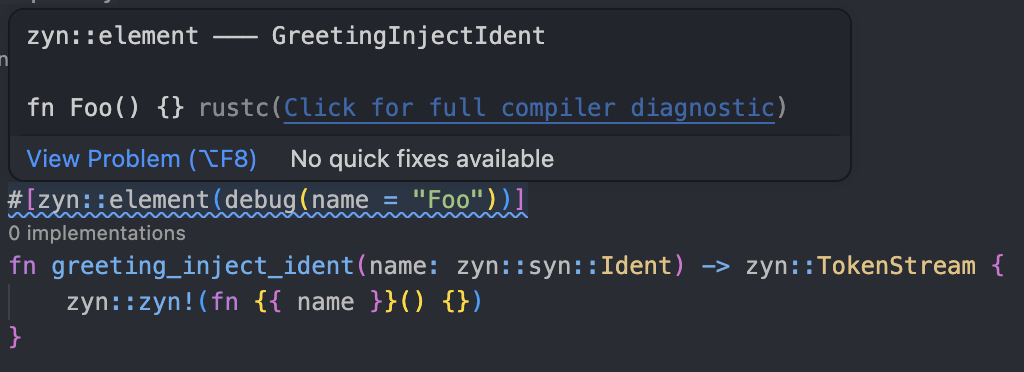
Note
Injected prop resolved at proc-macro time — the output shows the real value instead of a placeholder.
Note
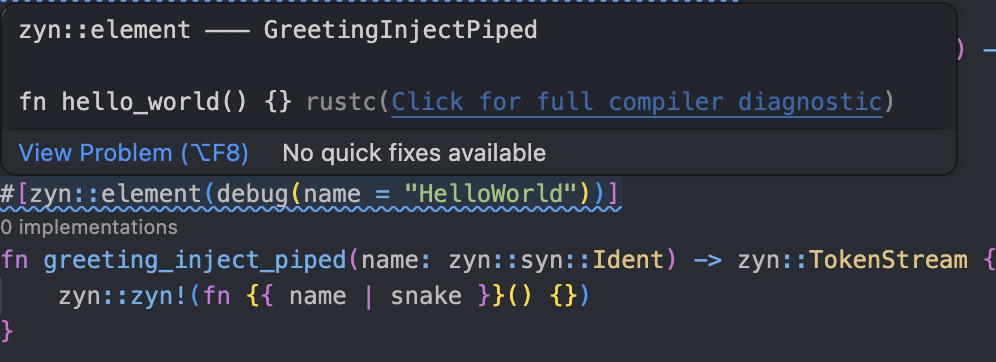
Injection with a pipe transform applied —
name = "HelloWorld"piped throughsnakeproduceshello_world.
Uninjected props
Any prop without a matching injection key renders as {{ prop_name }}. This is intentional — it makes unresolved placeholders visually distinct from real tokens.
Output formats
Raw (default)
The default format emits the raw TokenStream::to_string() output. This is a flat, single-line string with fully-qualified paths and spaces between all tokens. No extra dependencies are required.
#[zyn::element(debug)]
fn greeting(name: syn::Ident) -> zyn::TokenStream {
    zyn::zyn!(fn {{ name }}() {})
}
ZYN_DEBUG="Greeting" cargo build
note: zyn::element ─── Greeting

      fn {{ name }}() {}
  --> src/lib.rs:1:1
The raw format is useful for quick checks and when you want to see the exact tokens being generated.
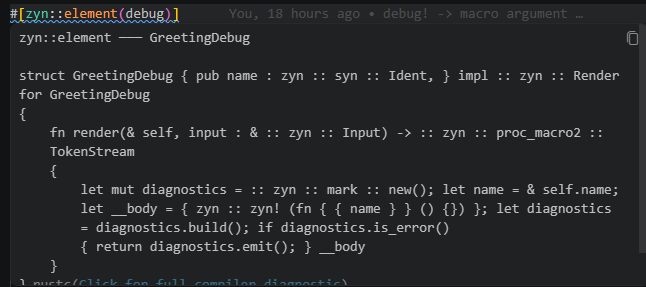
Note
Raw debug output shown as an inline compiler diagnostic in the editor.
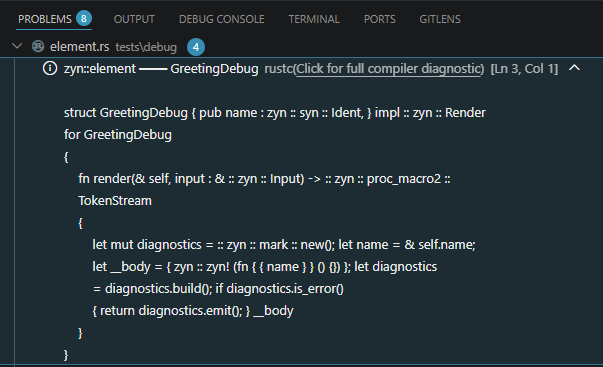
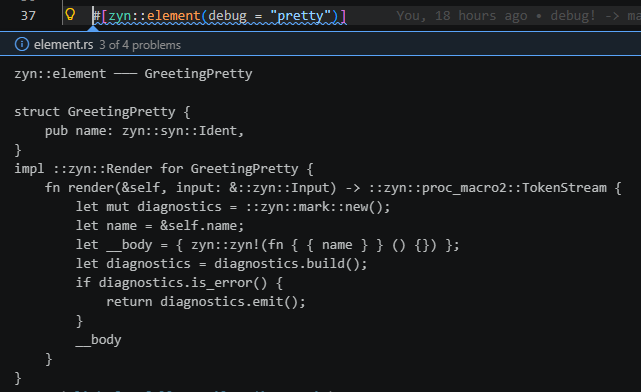
Note
The same raw output surfaced in the Problems panel for easy navigation.
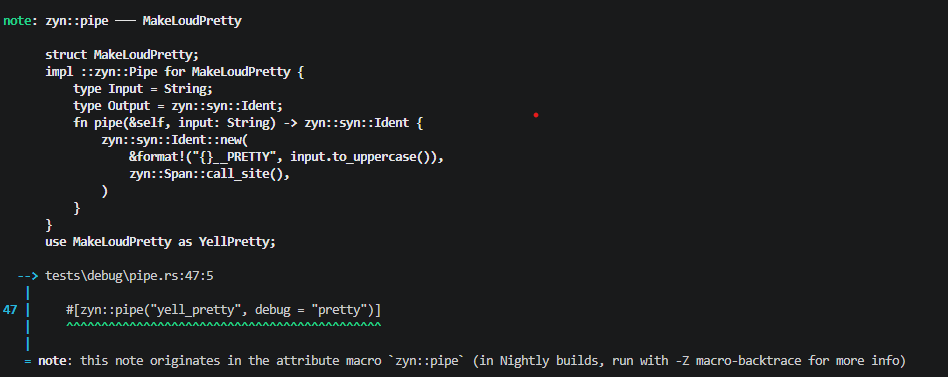
Note
Pretty-printed debug output in the console for a pipe.
Pretty (feature-gated)
The pretty option uses prettyplease to produce properly formatted Rust code with indentation and line breaks.
Enable the pretty feature in your Cargo.toml:
[dependencies]
zyn = { version = "0.4", features = ["pretty"] }
Then use debug(pretty):
#[zyn::element(debug(pretty))]
fn greeting(name: syn::Ident) -> zyn::TokenStream {
    zyn::zyn!(fn {{ name }}() {})
}
ZYN_DEBUG="Greeting" cargo build
note: zyn::element ─── Greeting

      fn {{ name }}() {}
  --> src/lib.rs:1:1
Note
Pretty-printed debug output — formatted with
prettypleasefor readable, indented Rust code.
If debug(pretty) is used without the pretty feature enabled, you’ll get a helpful compile error:
error: enable the `pretty` feature to use `debug(pretty)`
 --> src/lib.rs:1:16
  |
1 | #[zyn::element(debug(pretty))]
  |                ^^^^^^^^^^^^^^
Full output
Use debug(full) to emit the entire generated struct and impl instead of just the body:
#[zyn::element(debug(full))]
fn greeting(name: syn::Ident) -> zyn::TokenStream {
    zyn::zyn!(fn {{ name }}() {})
}
note: zyn::element ─── Greeting
struct Greeting { pub name : syn :: Ident , } impl ::zyn::Render for Greeting { fn render(&self, input : &::zyn::Input) -> ::zyn::Output { ... } }
--> src/lib.rs:1:1
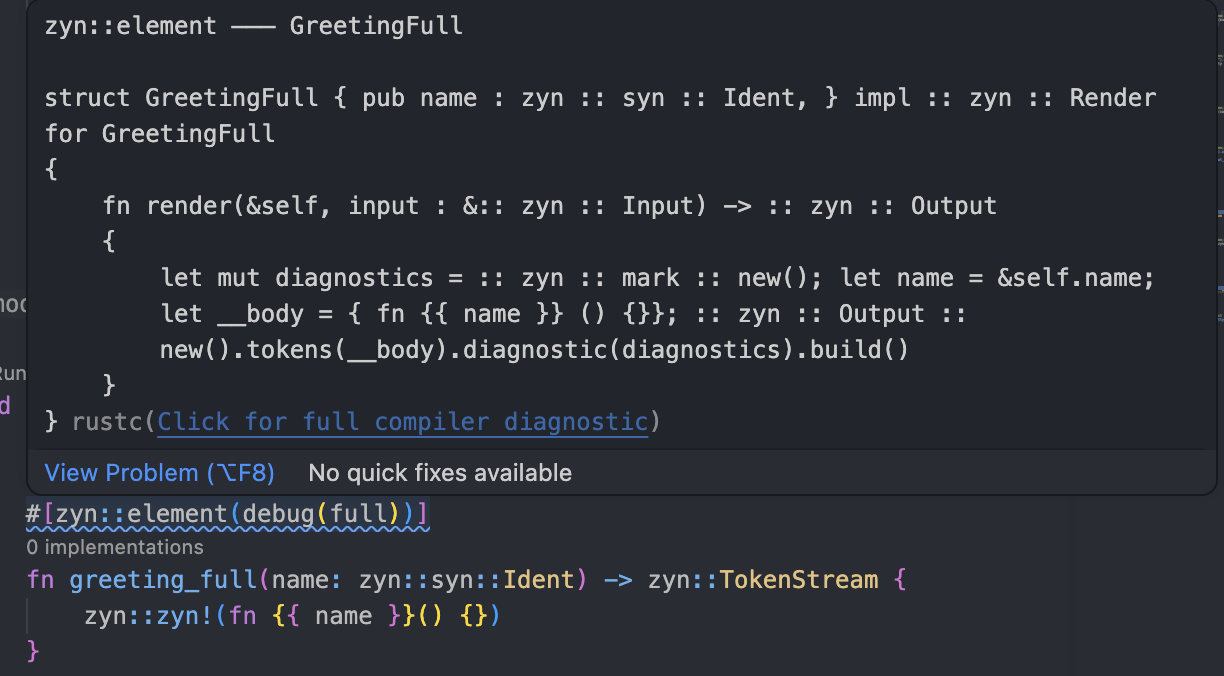
Note
debug(full)shows the entire generated struct andimplblock as a raw inline diagnostic.
Combine with pretty for formatted full output:
#[zyn::element(debug(pretty, full))]
fn greeting(name: syn::Ident) -> zyn::TokenStream {
    zyn::zyn!(fn {{ name }}() {})
}
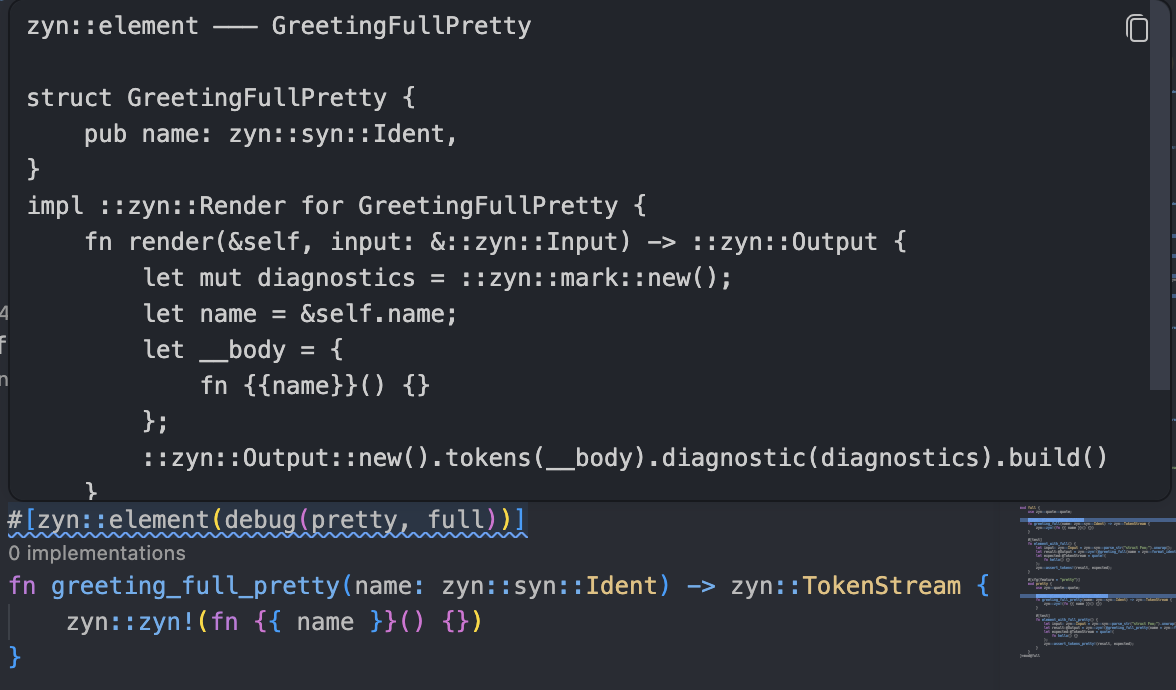
Note
debug(pretty, full)formats the full struct + impl withprettypleasefor readable, indented output.
ZYN_DEBUG environment variable
The ZYN_DEBUG environment variable controls which items produce debug output. It accepts comma-separated patterns with * wildcards, matched against the generated type name (the PascalCase struct name, not the function name).
For an element defined as fn greeting(...), the generated type is Greeting. For a pipe fn shout(...), the type is Shout.
| Pattern | Matches |
|---|---|
* | Everything |
Greeting | Exact match only |
Greet* | Greeting, GreetingElement, etc. |
*Element | FieldElement, GreetingElement, etc. |
Greeting,Shout | Greeting and Shout |
Greet*,Shout,*Pipe | Mix wildcards and exact |
ZYN_DEBUG="*" cargo build
ZYN_DEBUG="Greeting" cargo build
ZYN_DEBUG="Greet*" cargo build
ZYN_DEBUG="Greeting,Shout" cargo build
Noise stripping
Before formatting (in both raw and pretty modes), zyn strips internal boilerplate from the generated code:
#[doc = "..."]attributes — removes the doc comment blocks on generated diagnostic macros#[allow(...)]attributes — removes#[allow(unused)]and similarmacro_rules!definitions — removes the internalerror!,warn!,note!,help!, andbail!macro definitions
This keeps the debug output focused on the code you care about.
Full example
Given this element:
#[zyn::element(debug(pretty))]
fn field_getter(
    name: syn::Ident,
    ty: syn::Type,
) -> zyn::TokenStream {
    zyn::zyn!(
        pub fn {{ name | ident:"get_{}" }}(&self) -> &{{ ty }} {
            &self.{{ name }}
        }
    )
}
Running with ZYN_DEBUG="FieldGetter" cargo build (no injection — props show as placeholders):
note: zyn::element ─── FieldGetter

      pub fn {{ name | ident:"get_{}" }}(&self) -> &{{ ty }} {
          &self.{{ name }}
      }
With static injection to see realistic output:
#[zyn::element(debug(pretty, name = "title", ty = "String"))]
fn field_getter(
    name: syn::Ident,
    ty: syn::Type,
) -> zyn::TokenStream {
    zyn::zyn!(
        pub fn {{ name | ident:"get_{}" }}(&self) -> &{{ ty }} {
            &self.{{ name }}
        }
    )
}
note: zyn::element ─── FieldGetter
pub fn get_title(&self) -> &String {
&self.title
}
Pipeline API
For library authors building on top of zyn, the debug module exposes a pipeline API via the DebugExt trait:
use zyn::debug::DebugExt;

// Raw format — always available
let raw: String = tokens.debug().raw();

// Pretty format — requires `pretty` feature
#[cfg(feature = "pretty")]
let pretty: String = tokens.debug().pretty();